Healthcare • Marketplace • 2025
Versum Health
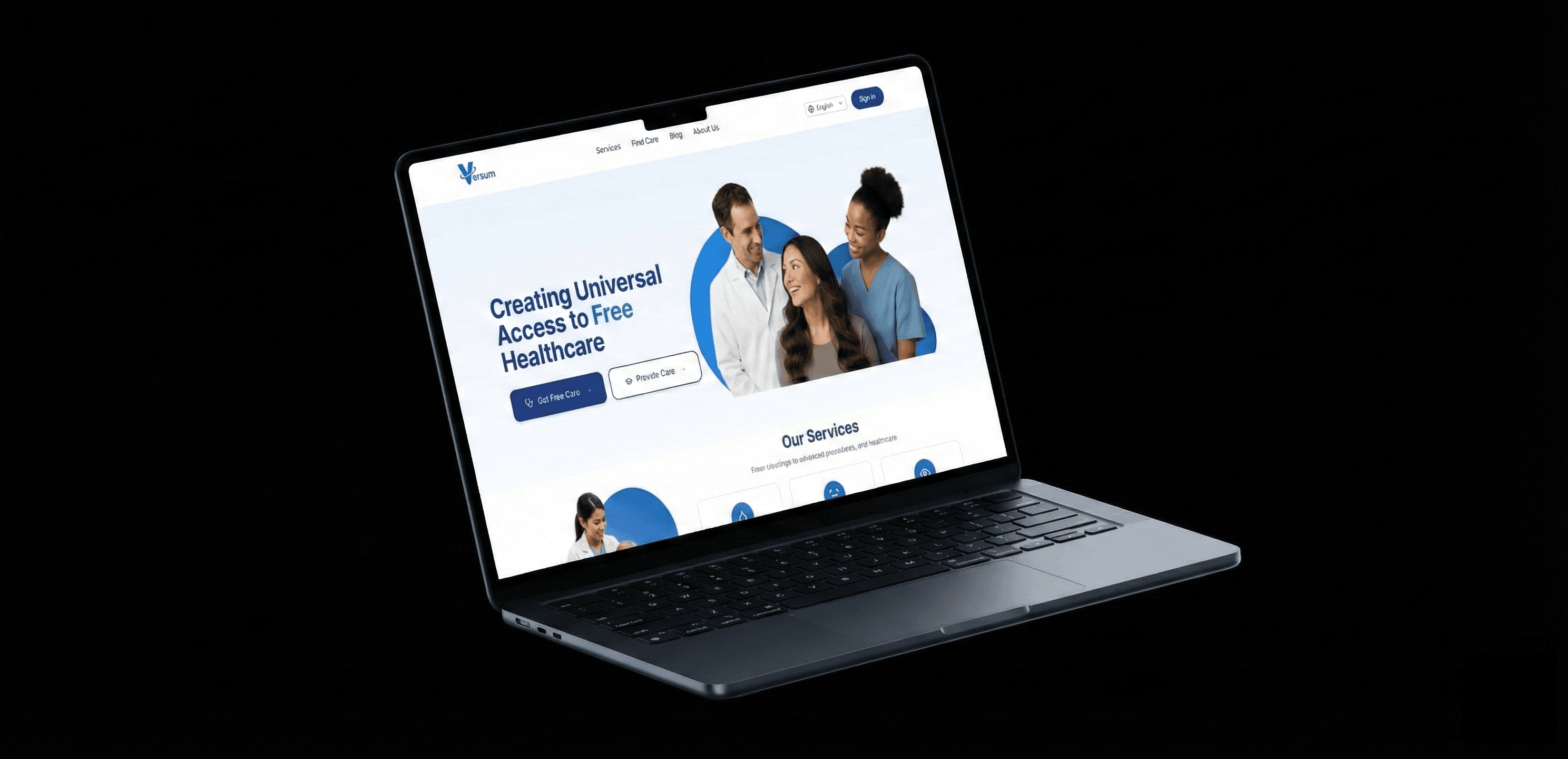
A marketplace connecting uninsured patients with supervised dental students for accessible, affordable care.
Role
Co-founder
Product Lead
Frontend Developer
Timeline
6 months
Research to MVP
Team
2-person team
Frontend & Backend
Skills
UX Research
Product Design
Prototyping
Overview
Versum Health connects uninsured patients seeking affordable dental care with dental students who need supervised clinical hours to graduate.
Patients get care. Students gain experience. Supervisors oversee quality. The platform eliminates the discovery problem that keeps both sides from connecting efficiently.
This two-sided marketplace creates a win-win: patients access affordable dental services while students fulfill graduation requirements under proper supervision. The infrastructure exists — dental schools, students needing hours, patients needing care — but there's no centralized platform to connect them, similar to how ZocDoc revolutionized finding doctors. Versum Health fills that gap.
Problem
74 million Americans lack dental insurance. Meanwhile, dental students struggle to find enough qualifying cases to complete their required clinical hours.
Patients can't afford care
Without insurance, routine dental visits cost $200-500+. Many postpone care until emergencies.
Students can't find cases
Dental students need specific procedure types to graduate. Finding qualifying patients is time-consuming.
No centralized platform exists
The infrastructure exists — dental schools, students, and patients — but there's nowhere to easily find and access it. Unlike regular doctor appointments (ZocDoc), there's no marketplace for student-supervised dental care.
Trust and safety concerns
Patients worry about student competency. The platform must clearly communicate supervision protocols.
"I haven't been to the dentist in 3 years. I know I need to go, but I can't afford it without insurance."
— Research participant, age 34
Research
I spoke with people on both sides of the marketplace to understand the real pain points.
Conversations
Practicing dental hygienist: "I really struggled to get patients to fulfill my clinical hours and almost didn't graduate. I had to pay people off the street a lot of money just to get them a free cleaning."
Potential patient: She goes to dental clinics through a friend who's a dental hygienist — easy for her to book because she knows someone. But she knows her friends can't do that. The connection problem is real.
Patient Pain Points
- • Can't find affordable options
- • Unclear pricing before visits
- • Scheduling is difficult
- • Worried about quality of care
Student Pain Points
- • Hard to find qualifying cases
- • Patients frequently no-show
- • Manual hour logging is tedious
- • Limited case diversity
Key Insight
The primary friction point is "finding each other" — not availability, not scheduling, not payment.
The infrastructure already exists: dental schools have students who need clinical hours, and there are millions of uninsured patients who need affordable care. But without a centralized platform like ZocDoc provides for regular doctors, these two sides can't easily discover and connect with each other. Versum Health creates that missing marketplace.
Personas
Patient
Alicia, 34
Situation: Uninsured gig worker, hasn't seen a dentist in 2+ years
Goal: Get a cleaning and checkup without spending $300+
Frustration: "I don't even know where to start looking for affordable care"
Needs: Transparent pricing, easy booking, appointment reminders
Student
Noah, D3 Student
Situation: Third-year dental student, needs 50+ supervised procedures to graduate
Goal: Find reliable patients for specific procedure types
Frustration: "Patients cancel last minute and I lose the whole day"
Needs: Case pipeline, automated logging, patient reliability signals
Solution
A centralized marketplace — think ZocDoc for student-supervised dental care — where patients browse and book, students manage their pipeline, and all procedures are confirmed under direct supervision.
Just as ZocDoc centralized finding doctors, Versum Health creates the first centralized platform for student-supervised dental care. Patients can search, filter, and book in one place — no more calling individual dental schools or hoping to find availability through word-of-mouth.
After validating the problem through research, we moved directly to prototyping in Cursor — iterating on the design through code rather than static mockups. This let us ship faster and make design decisions based on real interactions.
Patient Portal
Browse availability → Filter by procedure type → Request appointment → Confirm supervision acknowledgment → Receive reminders
Student Dashboard
View case pipeline → Accept/decline requests → Manage schedule → Log treatments → Track clinical hours automatically
Supervisor Oversight
Review scheduled procedures → Verify supervision → Approve hour logs → Manage student portfolios
Design Principles
Safety first: Consent, scope, and supervision confirmation are required before any booking.
Low friction: Minimal form fields, progressive disclosure for medical details.
Trust signals: Clear supervision badges, student credentials, and ratings visible throughout.
Patient Booking Flow
The patient experience prioritizes simplicity and trust. Three core screens guide users from discovery to booking.
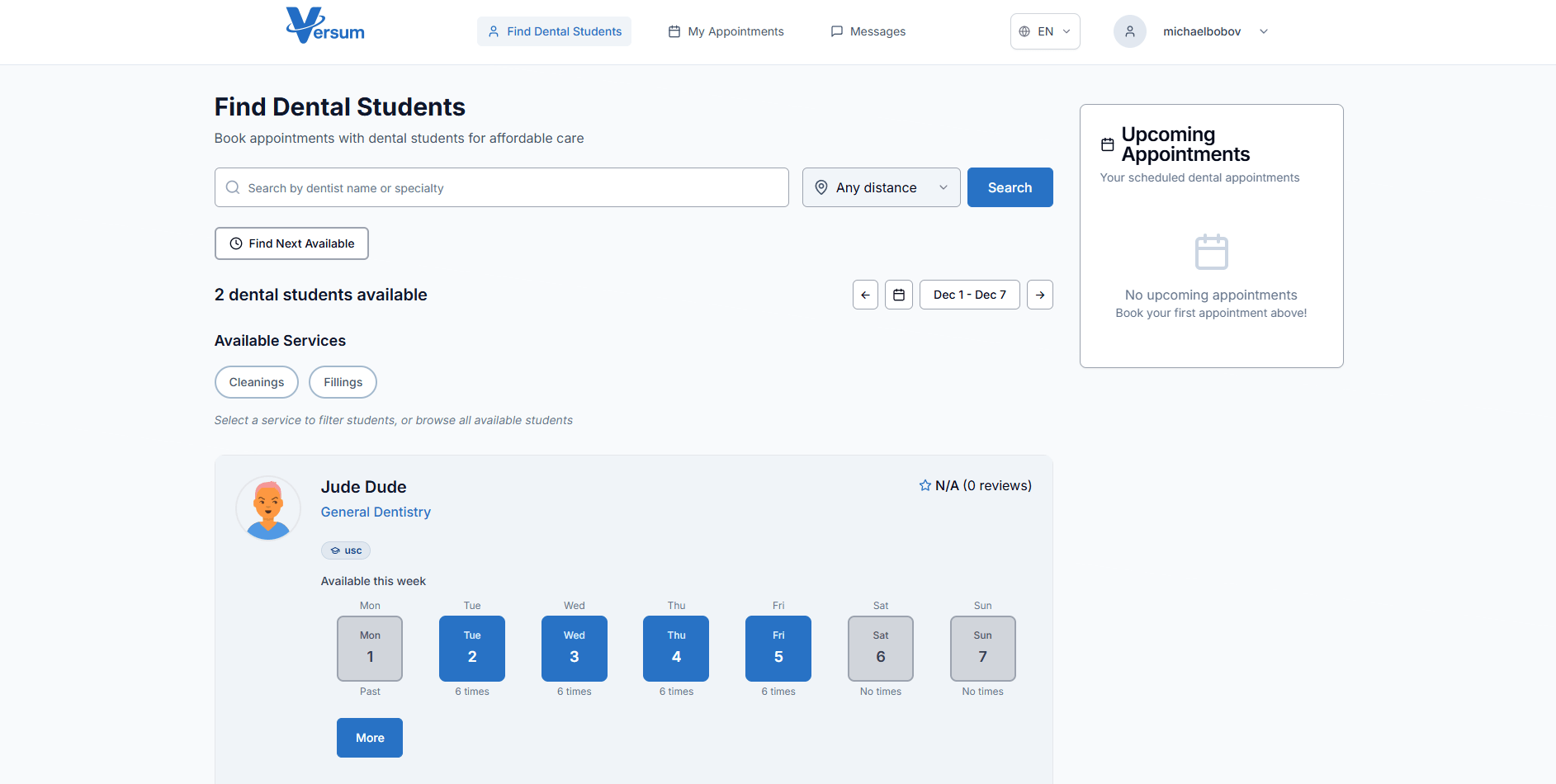
Find Dental Students
Patients search by specialty, filter by distance and availability, and view student profiles with credentials and ratings. Each listing shows the supervising faculty member and clinic location.
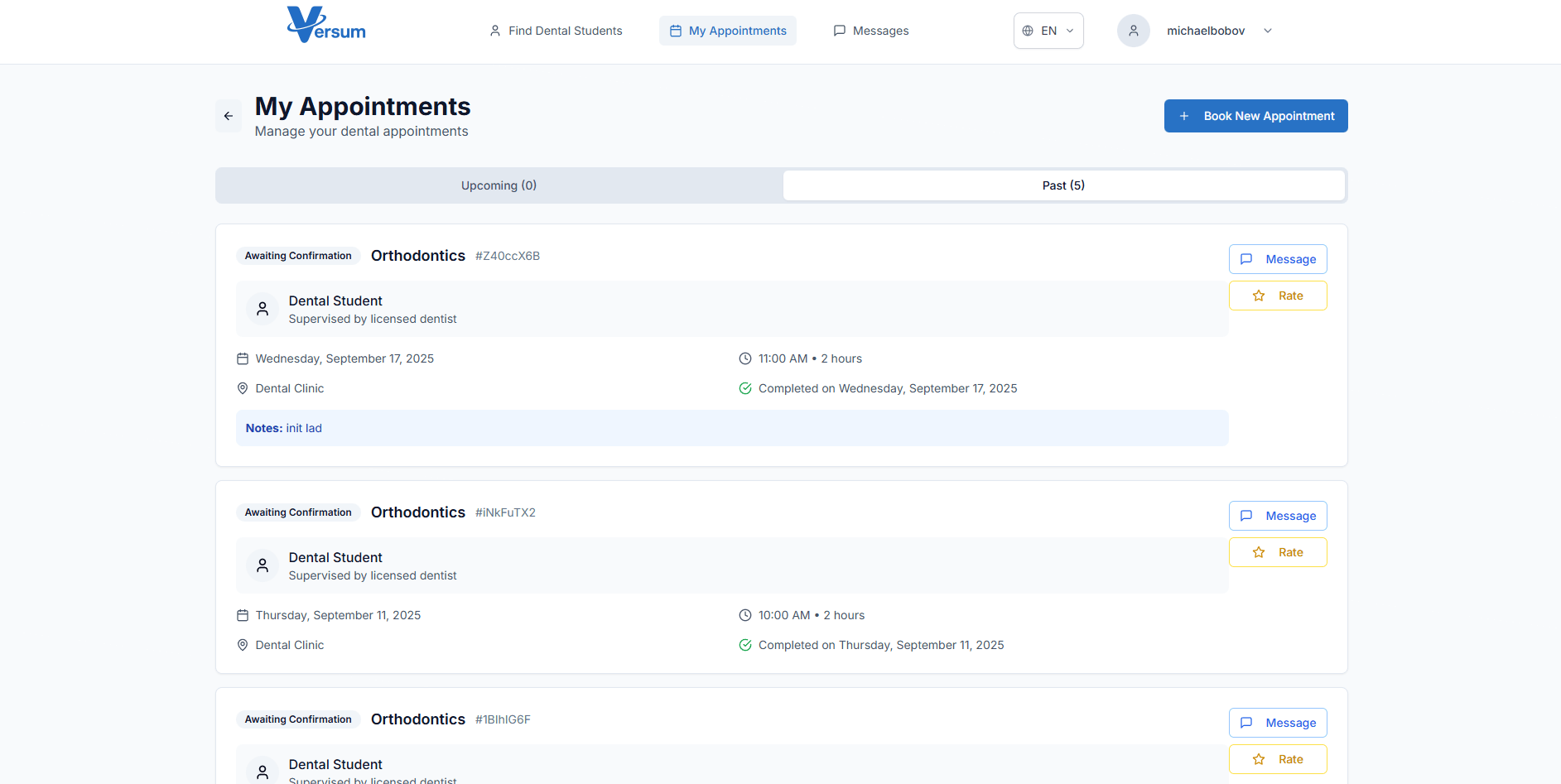
My Appointments
A central hub for managing all appointments. Patients can view upcoming visits, track completion status, access visit history, and leave reviews. The interface emphasizes clarity with color-coded status indicators.
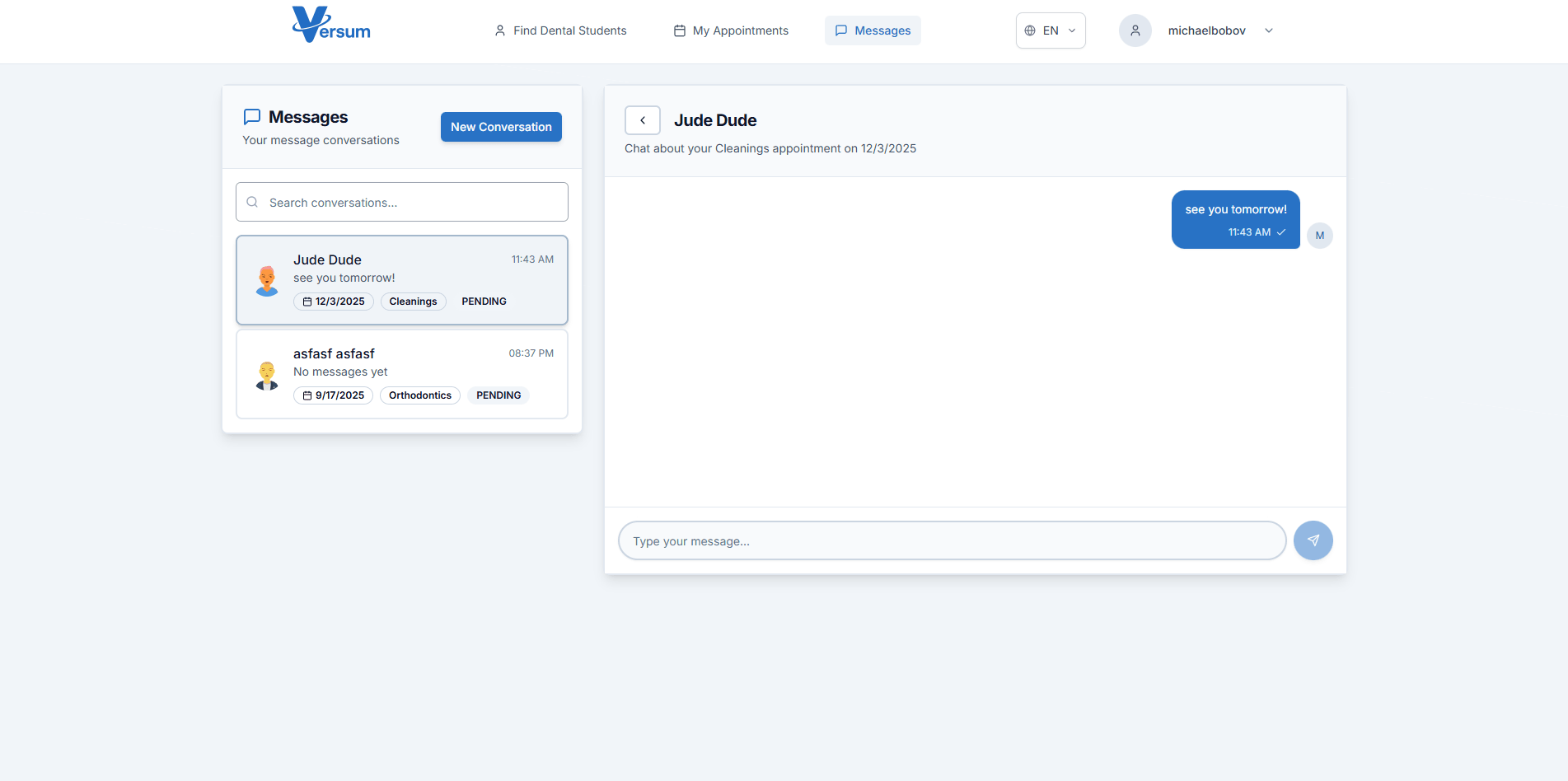
Messages
Direct, HIPAA-aware messaging between patients and dental students. Enables appointment coordination, pre-visit questions, and follow-up care discussions. Auto-saves conversation history for continuity.
Student Dashboard
The student experience focuses on managing their patient pipeline and availability.
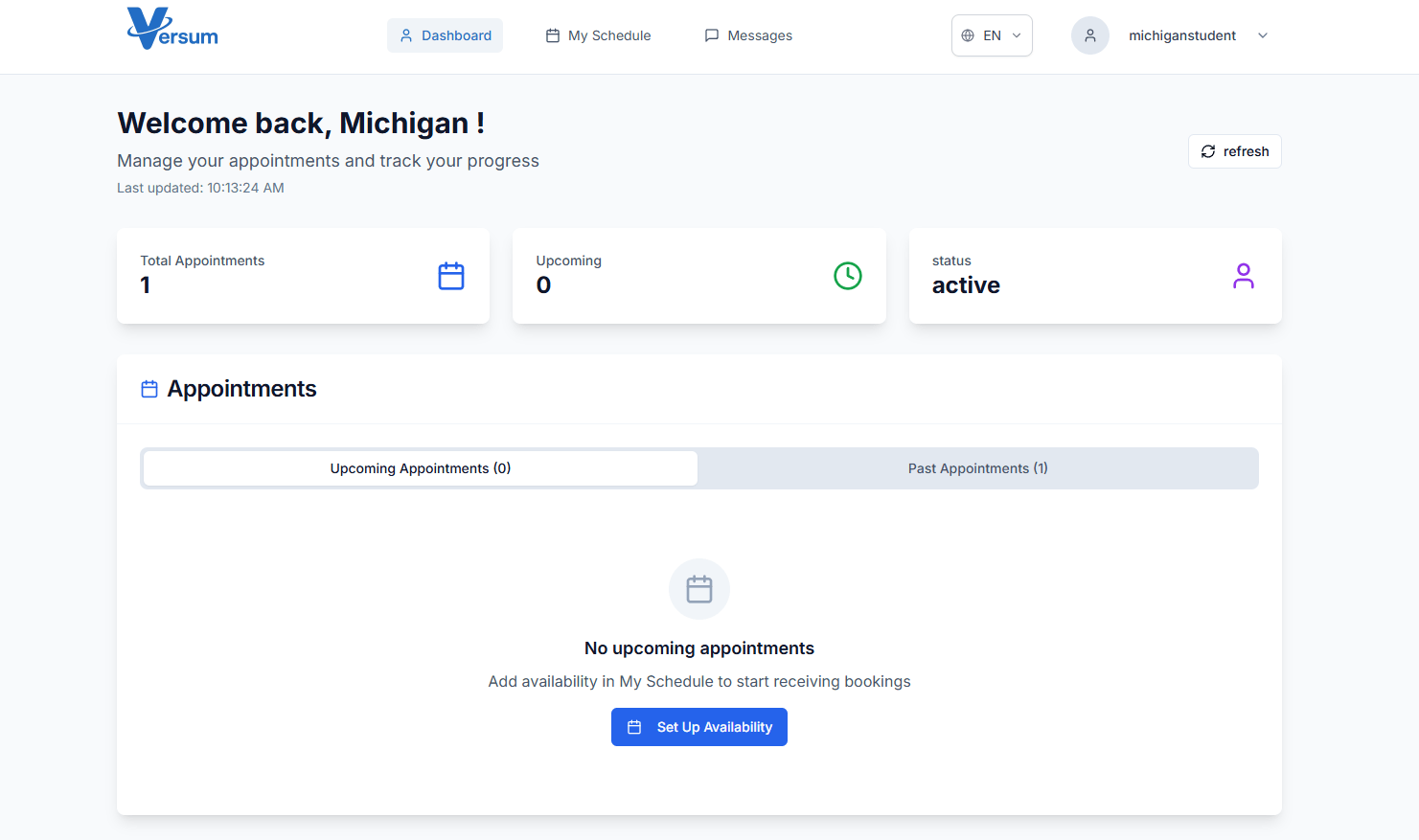
Dashboard
Students see all their booked appointments at a glance — upcoming visits, patient details, and procedure types. A clear overview to start each clinical day.
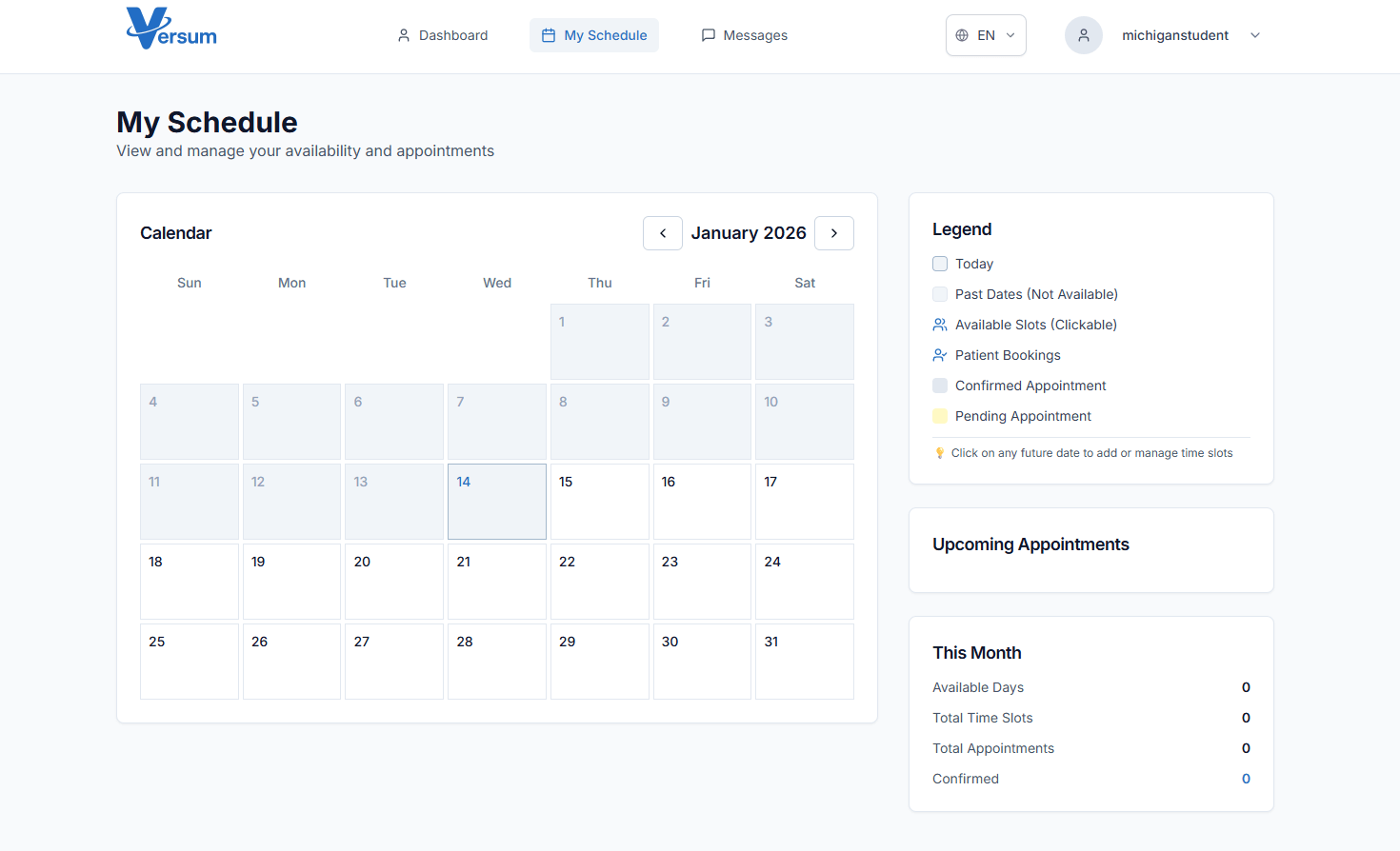
Availability Management
Students set when they're available for appointments. The interface shows existing time slots and makes it easy to add new availability windows.
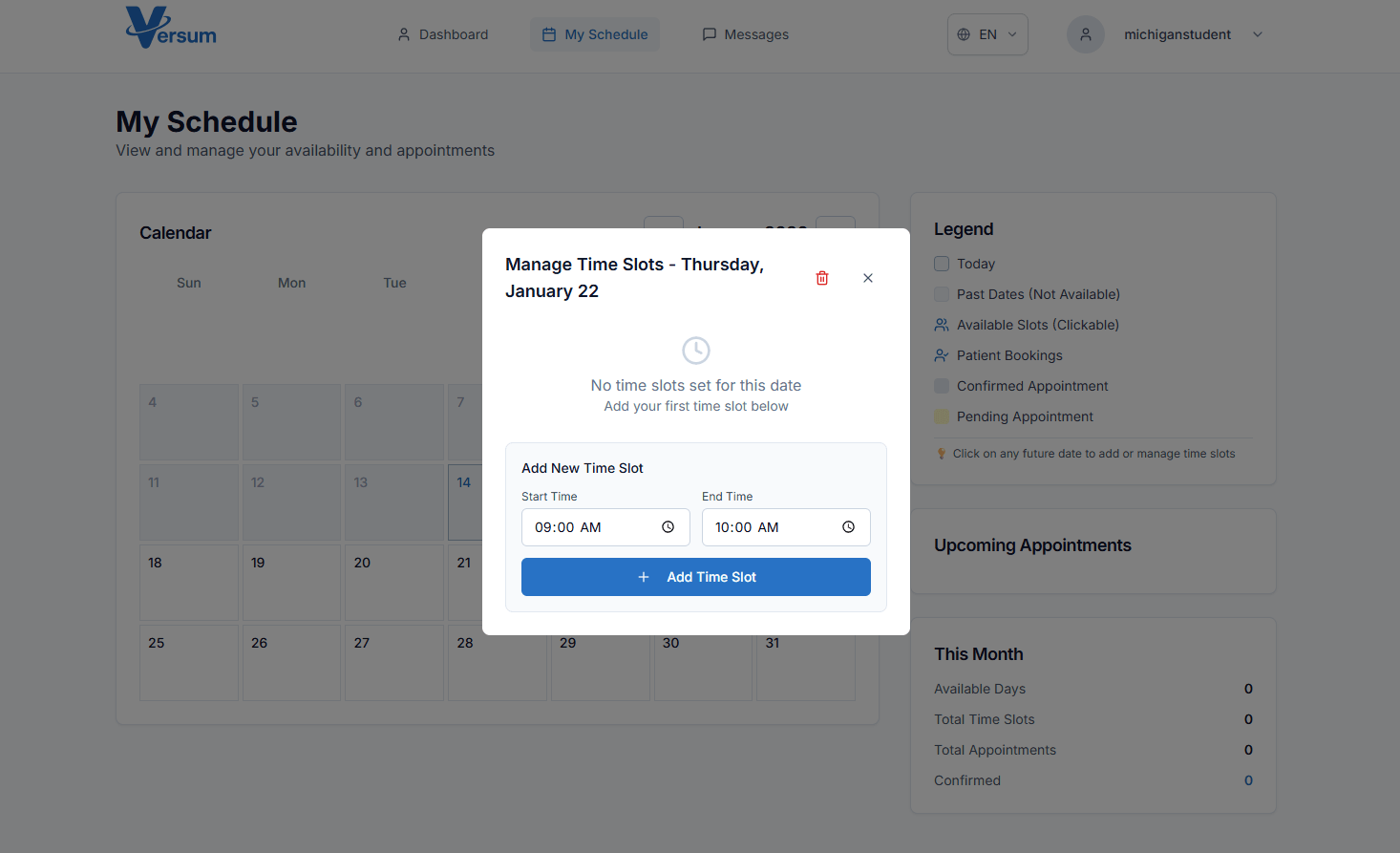
Time Slot Scheduler
The detailed scheduler for creating specific time slots. Students select dates, times, and which procedures they can perform during each window.
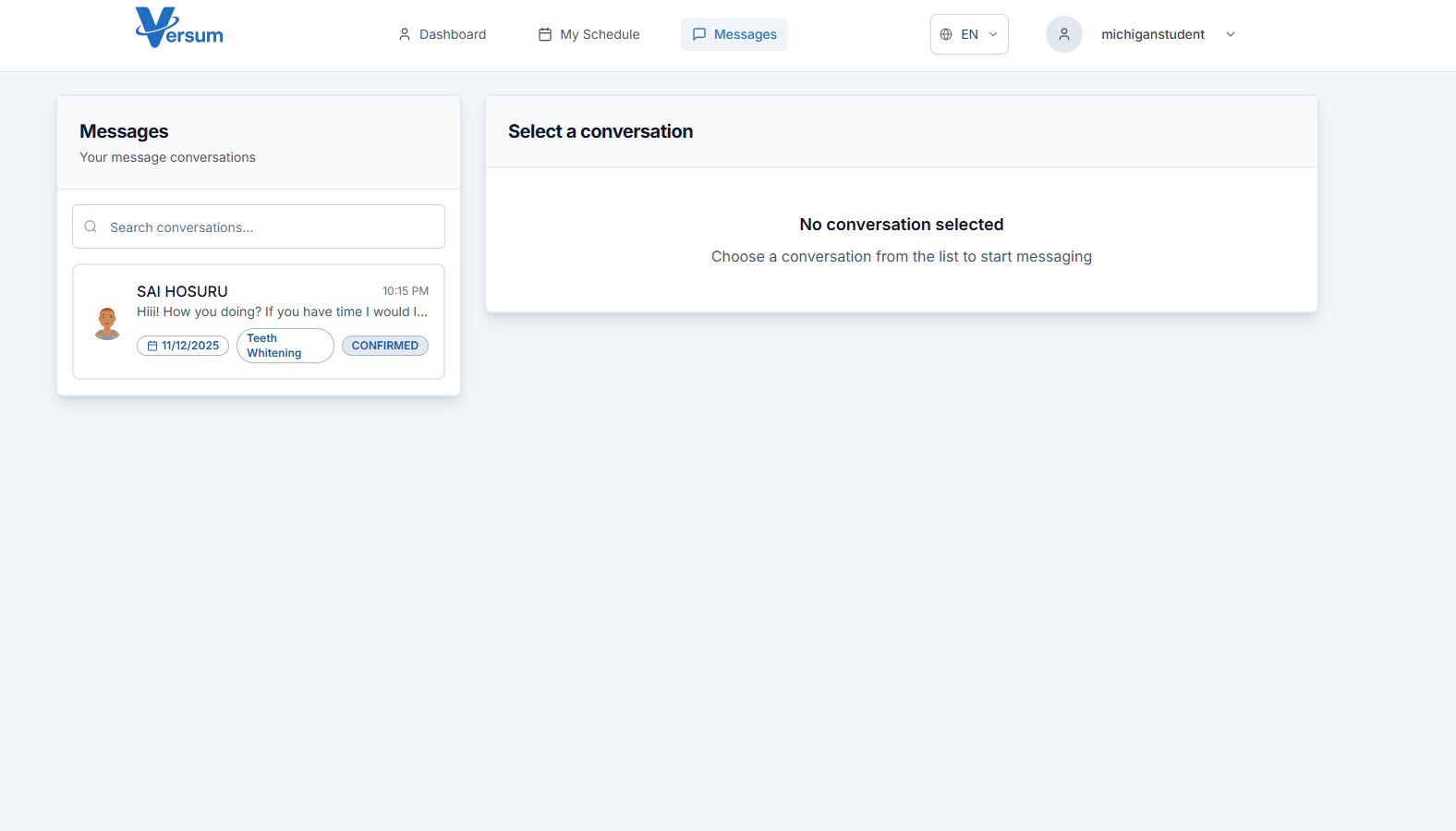
Messages
Direct communication with patients for appointment coordination, pre-visit questions, and follow-up care. Keeps all conversations organized in one place.
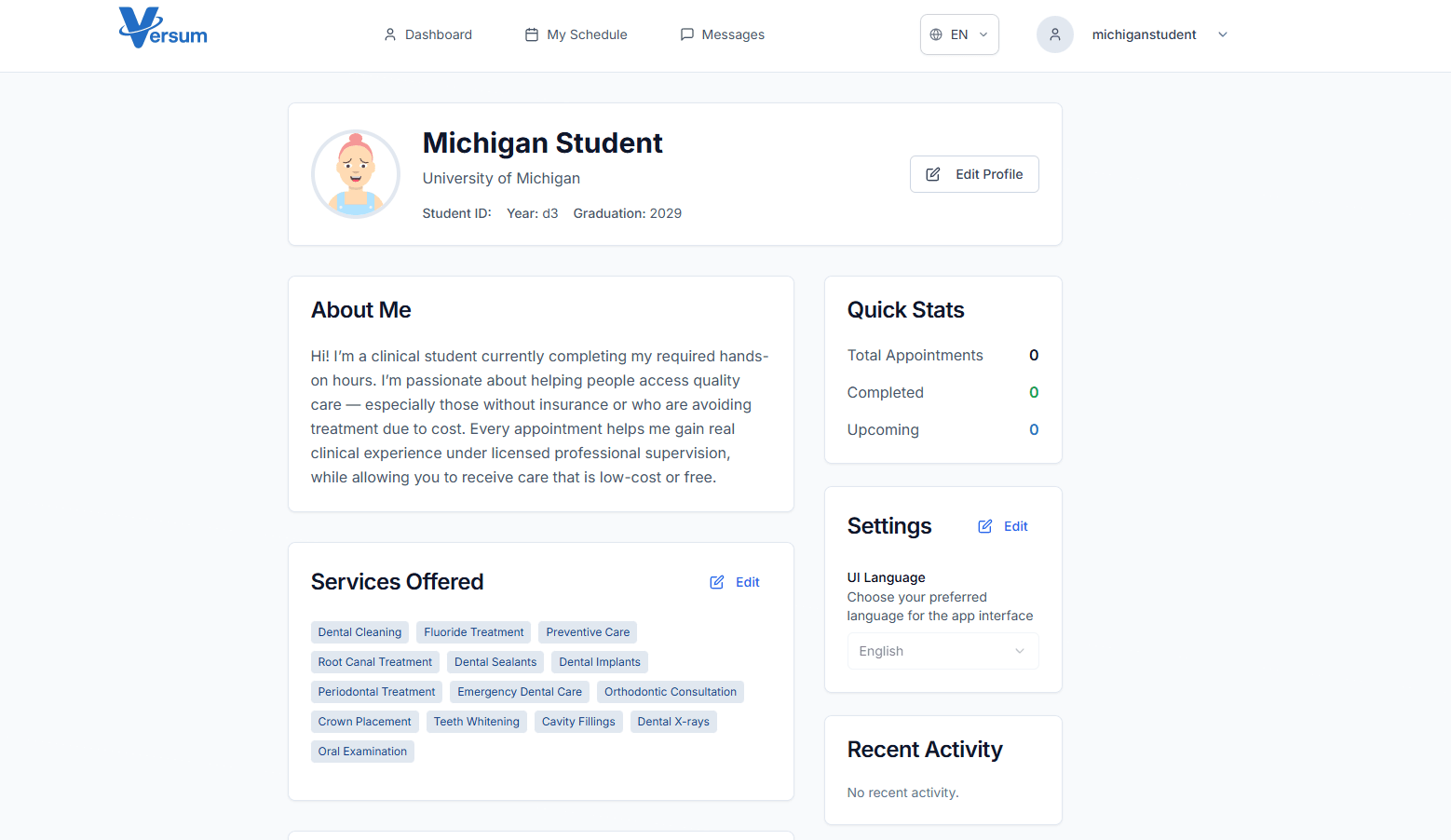
Profile & Services
Students customize their profile with the services they offer, credentials, and pricing (including free cleanings option). This information displays on their card when patients browse.
Design Decisions
Key trade-offs and rationale behind the design choices.
Task separation over unified dashboard
I considered a single-page dashboard, but users come with different goals. Separating Find, Appointments, and Messages reduces cognitive load and lets each screen focus on one job well.
Dual entry points for discovery
Some patients know what they need ("I need a cleaning"). Others browse by provider. Supporting both mental models in the Find tab removes friction for different user types.
Transparent pricing from day one
Cost anxiety is a major barrier for uninsured patients. Students indicate during onboarding if they offer free cleanings — this displays directly on their card. No hidden fees, no surprises at checkout.
History and future in one view
Patients often need context from past visits when scheduling new ones. Combining appointment history with upcoming visits creates continuity and reduces clicks.
Success Metrics
The metrics we're designing for and will measure as the platform grows.
<5 min
Target time to book
90%+
Target task completion
4.5/5
Target satisfaction
↓
No-show rate reduction
Current Status
MVP: Live at versumhealth.com
Outreach: Beginning conversations with dental schools
Next: Usability testing and pilot partnerships
Learnings
This project pushed me to think deeply about designing for trust in healthcare contexts.
01 Simplicity scales
The most powerful platforms do one thing exceptionally well. Versum Health's success will come from nailing the discovery-to-booking flow, not from feature bloat.
02 Healthcare + UX = Impact
Thoughtful design makes healthcare feel accessible rather than intimidating. Every UI decision either builds or erodes trust.
03 Real problems, real solutions
Building for a pain point I'd witnessed firsthand — friends avoiding dental care due to cost — led to solutions that resonated with every user I interviewed.
04 Two-sided marketplaces are hard
You need both sides to show up. The platform design must reduce friction for both patients AND students, or the marketplace never reaches critical mass.
Next Steps
The MVP is complete. Here's the roadmap for what comes next.
Supervisor Console
Verification tools, bulk approvals, and compliance dashboards for clinic administrators.
Eligibility Screening
Pre-visit questionnaires to match patients with appropriate procedure types and student skill levels.
Community Partner Integration
Partnerships with community health centers and nonprofits to widen patient reach.
Expand to Other Specialties
The model works for any healthcare training program — optometry, physical therapy, mental health counseling.
Final Thoughts
Versum Health isn't just about booking appointments — it's about making healthcare accessible to everyone, regardless of insurance status.
This project reminded me why I love product design: the ability to solve real problems for real people. Every decision — from the booking flow to transparent pricing on student cards — was grounded in research and empathy.
Versum Health is now live at versumhealth.com, and I'm excited to measure its real-world impact on patients and students alike.
Visit Live Site